Understanding Your Lab Results
How to use AI to explain medical lab results in plain English.
You got your blood work back. There are numbers, abbreviations, and terms you've never seen before. Your doctor said everything looks "mostly fine" but didn't explain the details. Sound familiar?
AI can help you understand what each result means — in plain English, without the medical jargon.
Important:
AI is not a doctor. Use it to understand your results, but always follow your doctor's advice. If something seems concerning, call your doctor's office.
Step 1: Gather Your Results
Find your lab results. They might be:
- In your patient portal (like MyChart)
- On a printed sheet from your doctor
- In an email from the lab
You'll want the specific numbers and test names. For example: "Glucose: 105 mg/dL" or "HDL Cholesterol: 45."
Step 2: Ask AI to Explain
Go to ChatGPT, Claude, or Gemini (see our "Trusted Sites" guide if you're unsure). Then type something like this:
Example message:
"I got my blood work results and I'm trying to understand them. Can you explain what these mean in simple terms?
Glucose: 105 mg/dL (reference range: 70-99)
Total Cholesterol: 210 mg/dL
HDL: 45 mg/dL
LDL: 130 mg/dL
Triglycerides: 175 mg/dL"
The AI will explain each one in plain language.
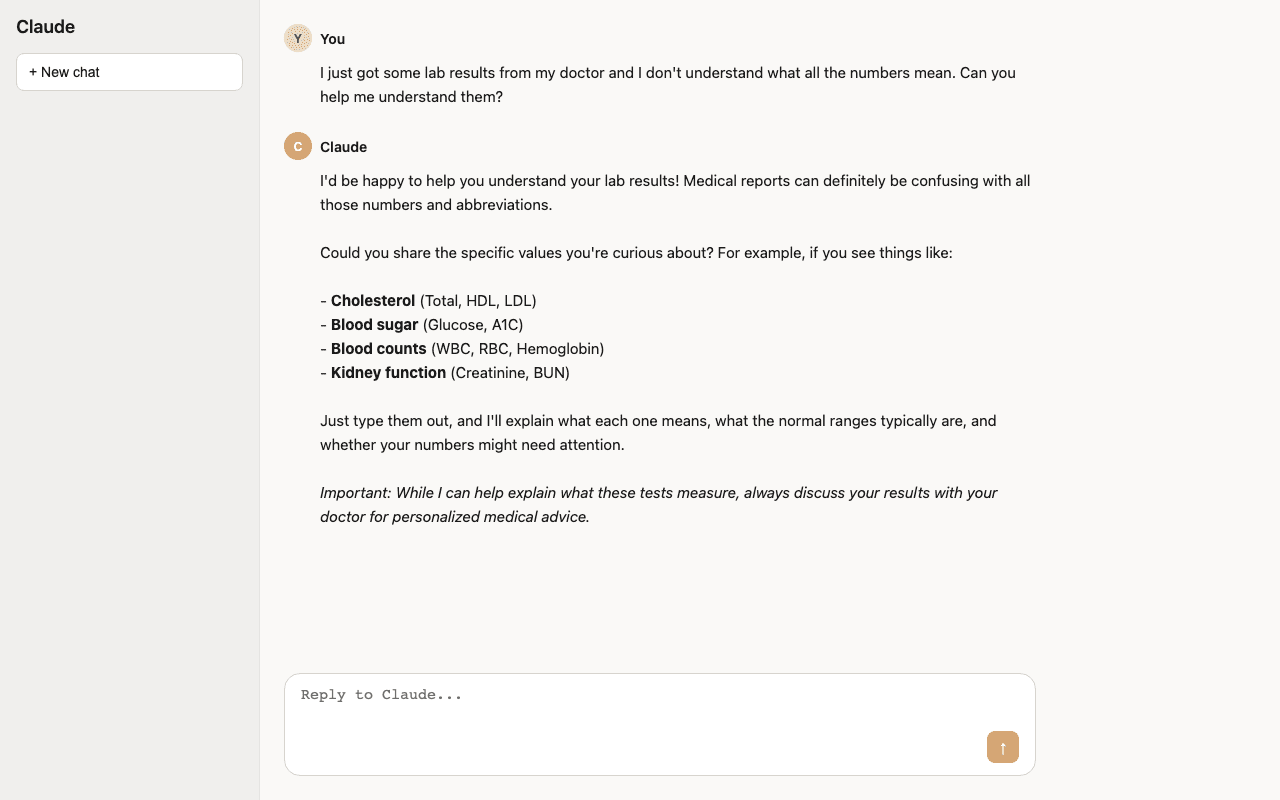
Here's what it looks like when you ask AI to explain lab results
Tip: Include the reference ranges from your report if they're listed. This helps AI give you better context.
Step 3: Ask Follow-Up Questions
Don't stop at the first answer! Ask questions like:
- "Is my glucose level something I should be worried about?"
- "What does 'borderline' mean for cholesterol?"
- "What lifestyle changes could help improve my HDL?"
- "What questions should I ask my doctor at my next visit?"
Example Conversation
You:
"My glucose was 105 and the normal range says 70-99. What does that mean?"
AI:
"A glucose level of 105 mg/dL is slightly above the normal fasting range (70-99 mg/dL). This is sometimes called 'prediabetes' or 'impaired fasting glucose.' It doesn't mean you have diabetes, but it's a signal that your body might be having a harder time managing blood sugar.
Many people improve this through simple changes like eating fewer sugary foods, walking more, or losing a few pounds if needed. Your doctor can give you specific guidance."
You:
"Should I be worried?"
AI:
"Not necessarily worried, but aware. Think of it as a yellow light, not a red one. It's your body saying 'pay attention to this.' The good news is that prediabetes is often reversible with lifestyle changes. Definitely bring it up with your doctor at your next visit."
What AI Can't Do
- AI cannot diagnose you. It can explain what results might mean, but only your doctor can diagnose conditions.
- AI doesn't know your full history. It only knows what you tell it in that conversation.
- AI can make mistakes. Always verify important health information with your doctor.
What's Next?
Sites You Can Trust →
Make sure you're using legitimate AI websites
Your First Conversation →
New to AI? Start here first
Understanding your health shouldn't require a medical degree. AI can be your translator.